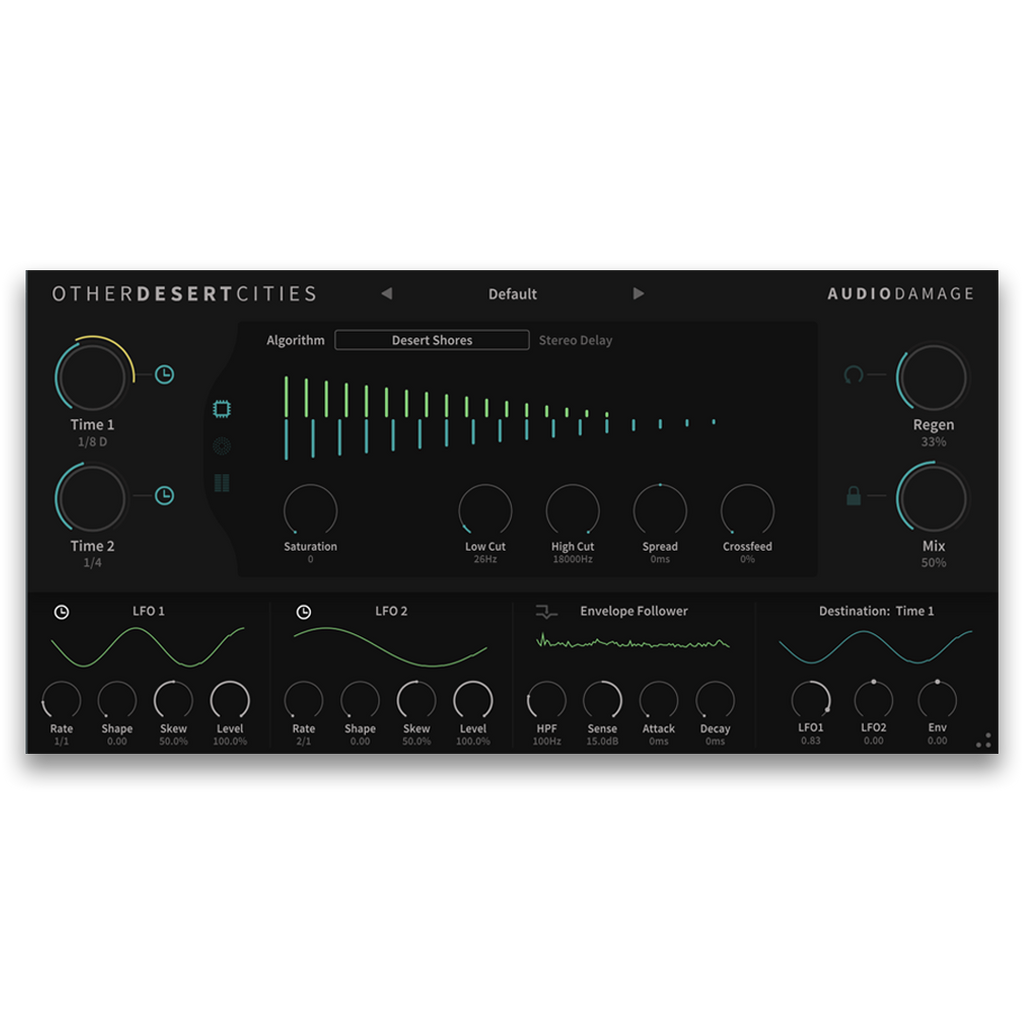
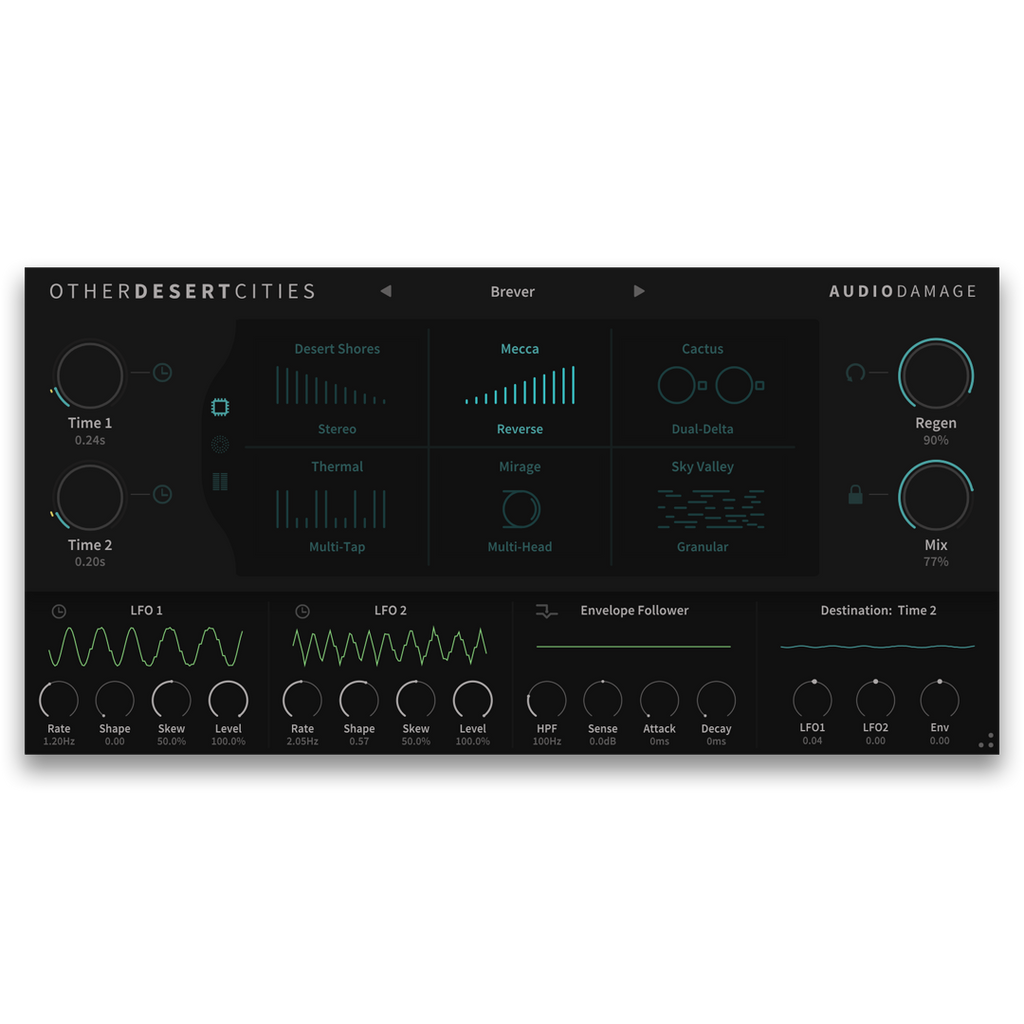
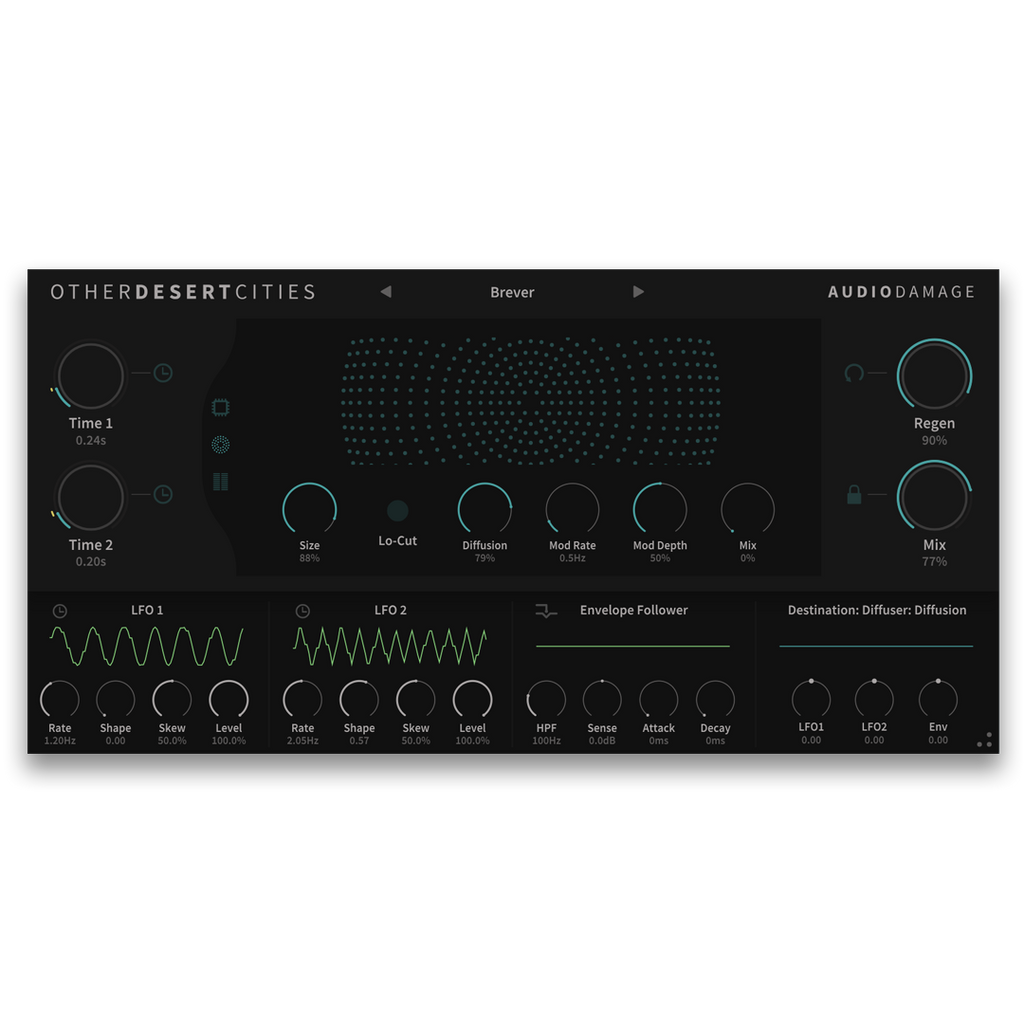
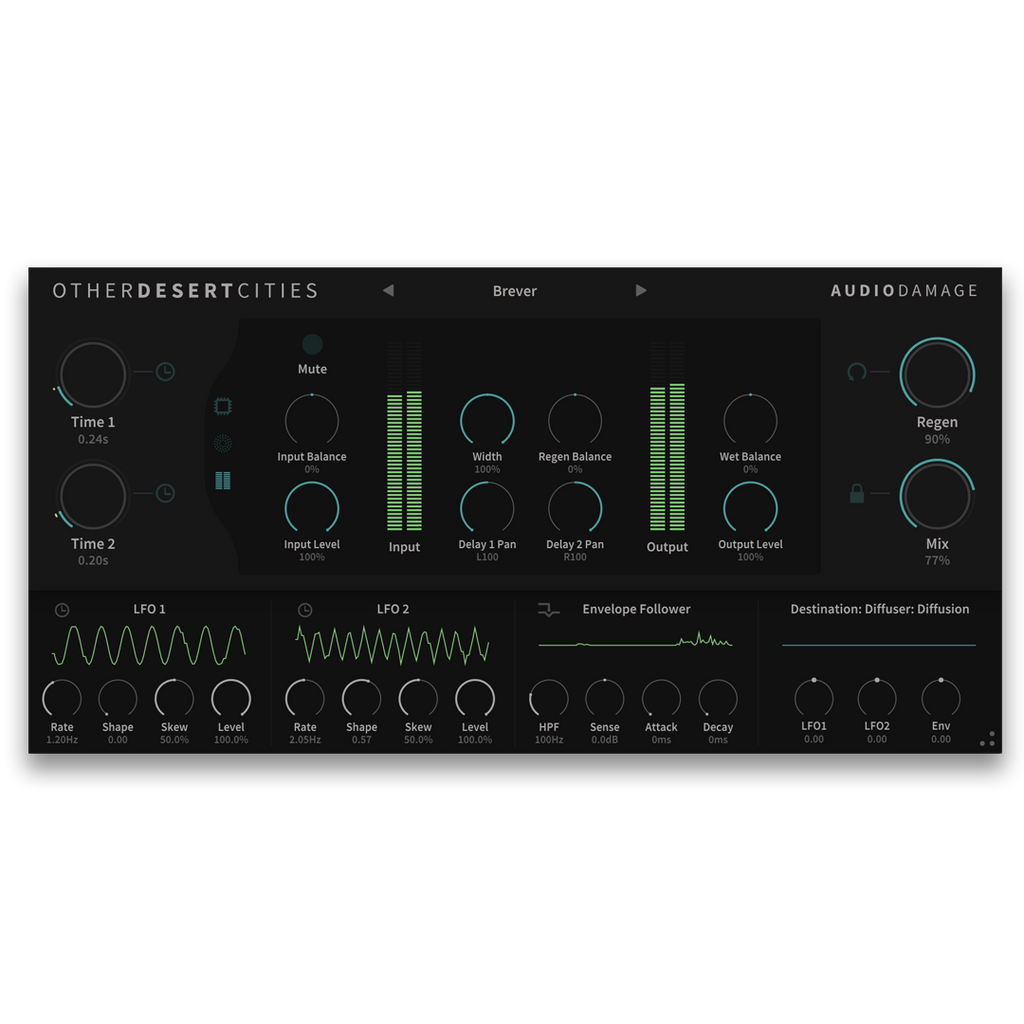
Other Desert Cities is a multi-algorithm delay plugin by Audio Damage for macOS, Windows, Linux, and iOS. Named after a famous sign on the I-10 highway leaving Los Angeles, it is a workshop for creativity: six delay algorithms, each with its own personality, running from a straightforward stereo dual delay through reverse, dual-delta, multi-tap, and multi-head machines to granular pitch-shifting chaos. Two tempo-synced LFOs and an envelope follower with stereo sidechain input modulate nearly every control, a diffusor smears the feedback path toward reverb, and the entire gain structure is open to modulation, so ducking delays and send-style tails come standard. Version 1.1.0 adds tap tempo, on screen or from a MIDI note or CC. Available as VST3, AU, AAX, and CLAP for desktop, and AUv3 for iPhone and iPad. Priced at $59 USD with no DRM, no subscription, and a perpetual license.
Fully functional demo. 20-minute session timer.
Run Desert Shores as the straight dub delay it wants to be, with saturation and crossfeed for vintage character. Flip to Mecca for reverse swells behind a vocal. Set Cactus's two speeds apart and quantize to fifths for harmonized repeats, or drag them below 1x for tape-style degradation. Spread Thermal's taps and bring up the diffusor for a reverb that is not quite a reverb. Let Mirage chew on a drum bus. Feed Sky Valley a pad and scatter grains across the stereo field. Sidechain the envelope follower from your kick to duck the whole delay out of the way, and tap in the tempo when you are playing without a clock.
What is Other Desert Cities?
Other Desert Cities is a multi-algorithm delay plugin: six distinct delay machines in one, from a standard stereo dual delay to reverse, variable-speed, multi-tap, multi-head, and granular pitch-shifting algorithms. It adds a diffusor in the feedback path, two LFOs and an envelope follower for modulation, and complete control over the gain structure. It is named after a famous sign on the I-10 highway leaving Los Angeles.
What are the six algorithms?
Desert Shores is a standard stereo dual delay with EQ, saturation, crossfeed, and spread. Mecca is a reverse delay. Cactus is a dual-delta delay, like a pair of tape decks with individual speed controls and pitch quantizing. Thermal is a dual multi-tap with sixteen taps per side. Mirage is a multi-head delay, as if the head of a tape delay were the rotating head of a VCR. Sky Valley is a pitch-shifting granular delay with control over grain size and scatter.
What can the modulation system do?
Two tempo-synced variable-waveshape LFOs and an envelope follower, sourced from the main input or a stereo sidechain, can be routed to nearly every control in the user interface: delay times, feedback, mix, panning, levels, the diffusor, and the algorithm-specific controls. Sidechain the envelope follower to duck the delay under a vocal or kick.
Does Other Desert Cities have tap tempo?
Yes, as of version 1.1.0. Set the sync source to Tap and every synced delay time and LFO follows the tapped tempo instead of the host. Tap on screen, or assign a MIDI note or CC and tap from a controller. The iOS AUv3 accepts MIDI input directly.
Does Other Desert Cities work on Linux?
Yes. Other Desert Cities is available as CLAP, VST3, and LV2 for Ubuntu 20 and later. macOS, iOS, and Windows builds are also available. All Audio Damage plugins are released for Linux alongside macOS, iOS, and Windows.
What plugin formats does Other Desert Cities support?
CLAP, VST3, and AAX on Windows 10 or newer. CLAP, VST3, AAX, and AudioUnit on Intel and Apple Silicon macOS 10.13 or newer. CLAP, VST3, and LV2 on Ubuntu 20 or later. AUv3 on iOS 16 or later. All desktop builds are 64-bit.
Does Other Desert Cities use copy protection, require a subscription, or need iLok?
No. Like all Audio Damage products, Other Desert Cities uses no copy protection of any kind. You can install your purchase on every machine you own. It is a perpetual license, not a subscription, and there is no online activation requirement after install.